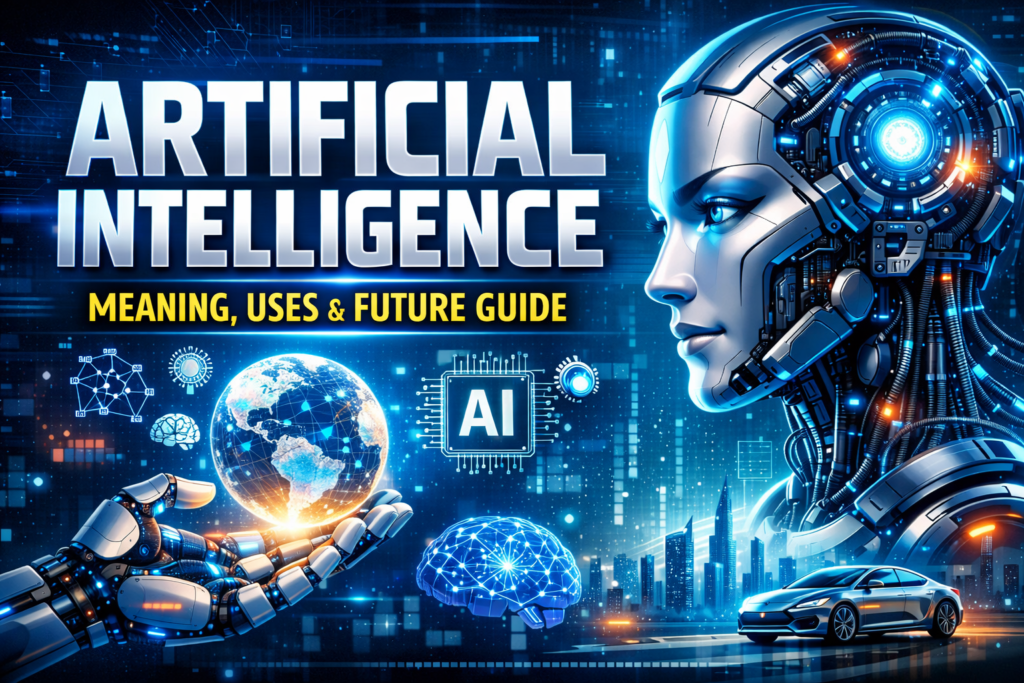
Artificial Intelligence (AI) is one of the fastest-growing technologies in the world today. It’s not only making computers smarter but also transforming the way humans think, work, and make decisions. From smartphones and social media to online shopping, healthcare, and education—AI is quietly but effectively at work everywhere.
Today, AI is no longer limited to experts or engineers. This technology has become an integral part of ordinary people’s daily lives. However, many people still don’t understand what Artificial Intelligence truly is, how it works, and what its advantages and disadvantages are.
What is Artificial Intelligence AI
Artificial Intelligence (AI) is a technology that gives machines the ability to think, learn, and make decisions like humans. In simple terms, AI is a type of computer-based intelligence that can analyze data and make smart decisions. Today, when you search for something on Google, YouTube recommends videos to you, or your mobile phone unlocks using facial recognition—Artificial Intelligence is working behind the scenes in all of these instances.
Previously, computers only followed given instructions. But with the help of Artificial Intelligence, machines can now learn from data themselves. This is made possible by technologies like Machine Learning and Deep Learning. This is why AI is no longer just science fiction, but a part of real life.
👉 Have you ever wondered how Netflix knows which movie you’ll like? That’s the power of AI.
The main goal of Artificial Intelligence is to solve problems, increase efficiency, and reduce human effort. This is why AI is being rapidly adopted in fields such as business, healthcare, education, and marketing.
Artificial Intelligence (AI) Meaning in simple terms
Artificial Intelligence (AI) means “artificial intelligence.” This refers to intelligence created by humans but that functions like the human brain. It includes abilities such as thinking, learning, reasoning, and problem-solving.
Just as a child learns through repeated practice, AI learns by analyzing data. The only difference is that AI can analyze millions of data points in a matter of seconds. This is why Artificial Intelligence is proving to be faster than humans in many areas.
👉 AI doesn’t get tired, doesn’t forget, and can work 24/7—which is why the world is compelled to adopt it.
Today, Artificial Intelligence is being used in voice assistants (Alexa, Siri), chatbots, smart cameras, and recommendation systems. Search engines like Google also use AI to provide users with better results.
In simple terms, AI makes computers “capable of thinking.”
How does Artificial Intelligence (AI) work?
Artificial Intelligence (AI) works with data. The more data, the smarter the AI. Its working process can be understood in three steps:
- Data Collection – images, text, videos, numbers
- Training – algorithms learn patterns from the data
- Decision Making – providing output based on the learned patterns
Machine Learning is the core of AI, where the system learns on its own. Deep Learning uses neural networks, which function similarly to the human brain.
👉 The more you teach AI, the smarter it becomes—just like humans.
For example, an email spam filter. Initially, the AI doesn’t know which emails are spam. But as it sees millions of emails, it learns on its own what constitutes spam.
This learning process is what makes Artificial Intelligence so powerful.
Uses of Artificial Intelligence (AI) in Daily Life
Artificial Intelligence (AI) has become a part of our daily lives. We often use AI without even realizing it.
Daily life uses:
- Face unlock on smartphones
- Traffic prediction in Google Maps
- Online shopping recommendations
- Voice assistants
- Fraud detection
👉If AI were to shut down one day, half of the world’s digital services would stop working.
In healthcare, AI is detecting diseases. In education, it’s making personalized learning possible. In business, AI is increasing profits by analyzing customer behavior.
The biggest advantage of Artificial Intelligence is that it simplifies complex tasks.
Benefits of Artificial Intelligence (AI)
Artificial Intelligence (AI) has many powerful benefits:
- Speed and accuracy
- Reduced human errors
- 24/7 availability
- Cost savings
- Better decision-making
AI can work in dangerous environments, replacing humans. AI assists doctors in analyzing medical reports.
👉AI doesn’t take away human jobs; instead, it makes work smarter.
Business owners are automating marketing, content, and customer support with AI tools. This is why Artificial Intelligence (AI) is considered a future-ready technology.
The disadvantages of Artificial Intelligence (AI)
Artificial Intelligence (AI) is a powerful technology, and its use requires equal responsibility. AI offers many benefits, but it also has drawbacks that cannot be ignored. The biggest concern is job automation. The increasing use of AI and robots is threatening many traditional jobs, especially in sectors like manufacturing, customer support, and data entry.
Another major drawback is data privacy and security. Artificial intelligence works with vast amounts of data. If this data falls into the wrong hands, users’ personal information can be misused. Sometimes, AI systems collect and analyze user data without their knowledge, which can pose a threat to privacy.
- Fear of job automation
- Data privacy issues
- High implementation costs
- Lack of human creativity
👉The smarter AI becomes, the more data is hidden behind it — and that’s the biggest risk.
Another problem is bias. If AI is trained on flawed or biased data, its decisions can also be biased. This can lead to discrimination and unfair results, particularly in areas like hiring, loans, and law enforcement.
Furthermore, developing and maintaining AI systems is expensive. Adopting advanced AI technology is not easy for small businesses. Also, AI lacks human emotions, empathy, and creativity, which are essential in many situations.
Therefore, it is crucial to use Artificial Intelligence thoughtfully, adhering to ethical guidelines and with proper controls in place.
The future of Artificial Intelligence (AI)
The future of Artificial Intelligence (AI) is considered incredibly bright and transformative. In the coming years, AI will no longer be just a support technology, but will become a core part of every industry. In healthcare, AI will help doctors detect diseases earlier, in education it will promote personalized learning, and in business it will make decision-making smarter.
Self-driving cars, smart homes, and AI-powered robots are no longer just concepts, but are rapidly becoming a reality. With the help of Artificial Intelligence, machines will work in collaboration with humans, not replace them.
👉In the future, those who understand and utilize AI effectively will be the most competitive.
If you want to read reliable information about technology and AI in simple language, then Digimathur Reviews – Trusted Tech & AI Insights provides expert analysis and honest guides.
Experts believe that human-AI collaboration will be the biggest trend in the coming years. AI will handle repetitive and data-heavy tasks, while humans will focus on creativity, strategy, and emotions. This will lead to a tremendous increase in both productivity and innovation.
However, strong regulations, ethical guidelines, and transparency will be crucial to ensure that the future of AI is safe and beneficial. Governments and tech companies are working together on AI governance to prevent misuse.
Overall, Artificial Intelligence is a technology of the future that is poised to completely transform the way the world works.
FAQ : What is Artificial Intelligence (AI)?
1: What is Artificial Intelligence (AI)?
Artificial Intelligence (AI) is a technology that enables machines to think, learn, and make decisions like humans. AI systems understand patterns based on data and improve themselves over time.
2: In which areas is AI being used today?
Today, AI is being used in many fields such as healthcare, education, banking, marketing, automobiles, customer support, and content creation. Chatbots, voice assistants, and recommendation systems are common examples.
3: Will AI eliminate human jobs?
AI may automate some jobs, but it also creates new skill-based jobs. Those who learn to work with AI will have more opportunities in the future.
4: How to start learning Artificial Intelligence?
To learn AI, you can start with basic computer knowledge, data analysis, machine learning, and languages like Python. Many free and paid online courses are also available today.
5: What will be the role of AI in the future?
In the future, AI will play a major role in smart cities, health diagnostics, self-driving cars, and personal assistants. This technology will make life easier, faster, and more accurate.
Final Thoughts
Artificial Intelligence (AI) is one of the most influential and rapidly developing technologies of our time. It is not only transforming the way we work but also reshaping our thinking and decision-making processes. From smartphones to healthcare systems, AI has made its presence felt everywhere.
The advantages of AI make it future-ready, but its potential drawbacks also warrant caution. Striking the right balance is crucial—where AI provides efficiency and speed, human values and ethics must also be preserved.
👉AI is not the future—AI is the present, and those who understand it will thrive.
Artificial Intelligence (AI) is something to be understood, not feared. If used with the right knowledge, the right intent, and the right rules, it can prove to be a powerful partner for humanity.
Ultimately, AI is a tool. It is up to humans to decide whether they make it a boon or a challenge for society. Used in the right direction, Artificial Intelligence (AI) can make the world smarter, safer, and more efficient in the future.
Technology is changing rapidly, and if you want to stay updated on AI, tools, and smart decisions, following a trusted platform like Digimathur Reviews – Trusted Tech & AI Insights can be a smart move.
Explore More AI Insights ✅