Table of Contents
ToggleWhat if your biggest competitive advantage is slowly disappearing — not because of bad strategy, but because everyone is using the same AI brain?
At digimathurreviews, we explore how AI tools give companies speed today but risk originality, differentiation, and long-term power tomorrow.
The Same Brain for Every Company? Think Again
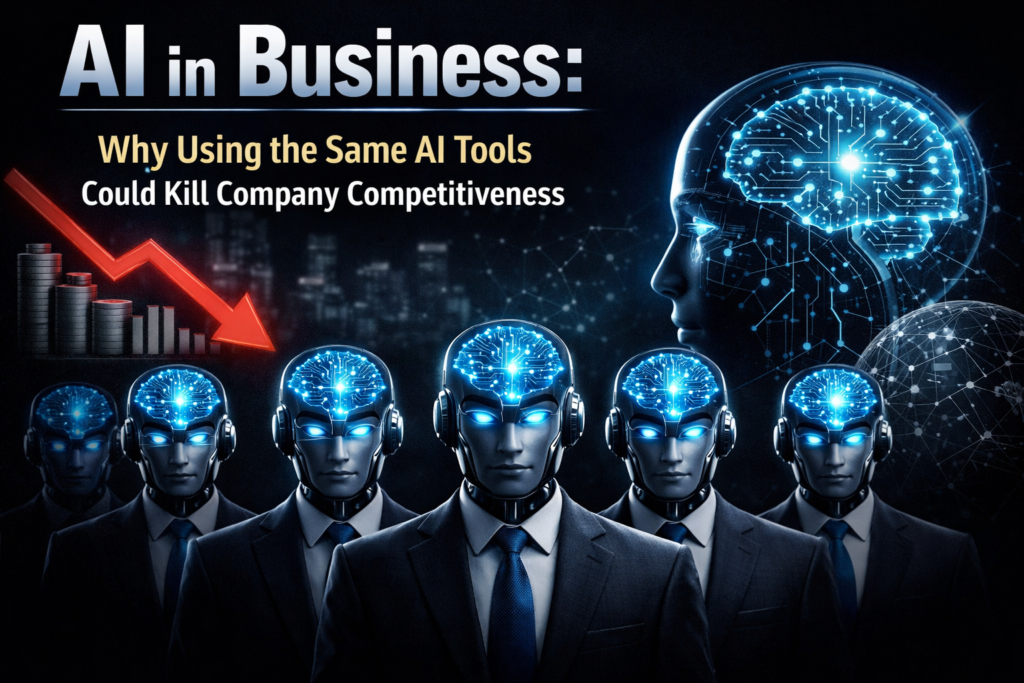
People have believed throughout history that Artificial Intelligence (AI) serves as the ultimate business equalizer because it can deliver operational efficiency and business expansion while providing companies with unmatched market intelligence. Companies across various sectors have quickly implemented AI technologies because they expect these tools to improve their work efficiency and creative abilities and their ability to make decisions. The rising number of organizations that use AI technologies creates a dangerous situation because the tools which organizations used to achieve their unique market identities now create a situation where all companies become increasingly similar. Businesses have lost their competitive edge because all market players now use identical AI technologies, which create a standard operational model that produces predictable results.
Today’s corporate environment requires businesses to compete against two challenges: human limitations and AI-driven operational processes. The current business world operates under systems which use AI technology for analytics and chatbots and generative tools and automated decision-making systems. The implementation of AI technology in business operations from marketing automation through customer service creates new work processes which boost operational efficiency to exceptional levels. The question arises whether companies can achieve competitive advantages if they all use identical AI technologies.
Efficiency Now, Creativity Lost Later
The main attraction of AI for business applications results from its capability to enhance standard operational workflows. AI systems can process large data collections to predict future developments while creating original artistic works at speeds that exceed human capabilities. Corporate executives are enamored with the idea that AI can reduce costs, minimize errors, and accelerate decision-making. The implementation of identical artificial intelligence solutions throughout organizations creates a paradox which results in widespread usage. The use of identical operational systems by companies leads to dual outcomes because their teams develop standardized procedures which result in uniform results, thus diminishing their distinct market position.
The world of marketing includes multiple aspects that require examination. The usage of identical AI-powered content generators and recommendation engines with social media analytics platforms by businesses leads to their campaigns developing similar styles and tones. A brand that had its own distinctive voice sees its identity vanish because people now associate it with other brands. Financial services that utilize identical AI risk models will respond to market signals with identical patterns of behavior, which will create herd movements that diminish their competitive strength. The system achieves efficient results when it sacrifices creative work, and the process of standardizing innovation leads to the disappearance of any distinctive elements.
When Innovation Becomes Standardized
The allure of artificial intelligence innovation shows itself as an irresistible force. The tools enable automatic execution of design work while producing code and offering product enhancement recommendations. The danger exists because companies will develop identical solutions through their use of artificial intelligence which operates on matching datasets and algorithms. The systems which creators built to generate new ideas will actually reduce their capacity to create fresh concepts.
The combined effect of speed and innovation requirement results in major consequences for industrial sectors which depend on these two factors. The technology sector depends on startups to use specialized technological advancements for their business model which enables them to compete against established companies. The introduction of AI-powered design tools and analytical tools and operational solutions to all users results in an even competitive environment. A small company using AI can scale as quickly as an established competitor but the outputs may yield identical results. AI systems which enforce standardized methods of work will diminish the competitive edge that organizations build through their human creativity and understanding and distinct workplace practices.
The implementation of artificial intelligence in business strategies leads organizations to choose automated optimization methods instead of human testing. The algorithms that choose efficiency and predictability as their main criteria create a situation where businesses need to reduce their experimental work which serves as the essential force behind their innovative progress. The study investigates how artificial intelligence affects business productivity while creating obstacles to their ability to create unique products which make them less competitive in the market.
AI in Charge: Who Really Wins?
The ultimate irony of widespread AI adoption is that it may benefit no one in the long term or at least not in the way companies hope. The strategic advantages of AI technology become available to competitors whom AI operationalizes because they can replicate its benefits through identical tools and similar models which produce the same outcomes. The result creates a market environment where businesses operate with identical knowledge and procedures and produce the same results.
Corporate AI strategy needs to transform itself because of this danger. Leaders must assess two aspects of AI systems, which include their present performance benefits and their future ability to create unique competitive advantages. The company achieves its unique benefits through the specific implementation of its digital tools within its organizational values and its methods for corporate decision-making and workforce management. AI systems boost creative output when they work together with human decision-making abilities, yet their uncontrolled use leads companies to adopt identical business processes across all their operations.
The Future of Work AI and Human Partnership
The process of AI development creates new workplace requirements which require organizations to create effective methods for blending automated systems with employee artistic work. AI tools excel at repetitive tasks, large-scale data analysis, and pattern recognition, but they struggle with ambiguity, intuition, and moral judgment. Human employees bring context, empathy, and innovative thinking that AI cannot replicate. Companies that use AI as their operational partner instead of treating it as a replacement will achieve better competitive advantage.
The collaboration needs to have dedicated corporate strategic planning. The organizations need to develop their employees through training programs while building workplaces that support innovation and implementing artificial intelligence systems which will enhance their creative production instead of making it uniform. The organizations need to develop specific strategies because they risk losing their competitive advantage through artificial intelligence which will create identical procedures and results across all of their business rivals.
Risks Beyond the Boardroom
AI innovation risks extend beyond competition and strategy. The application of standardized AI systems leads to increased market volatility while decreasing consumer options and driving industries toward standardization because companies need to follow standard operating procedures. Financial algorithms that aim to create maximum returns lead to interinstitutional trading correlations which result in increased market fluctuations. Marketing AI technology develops repetitive messaging patterns which limit consumer experience to basic content.
Complete corporate adoption of artificial intelligence technology will occur because regulatory requirements and ethical standards will become more influential over time. Business organizations face three different types of risks when they use artificial intelligence technology which need to be managed through proper control procedures. Companies that depend entirely on AI systems which focus on efficiency will find themselves unprepared to handle compliance requirements and algorithmic bias issues and public examination. The irony between short-term benefits and AI implementation shows how companies risk creating lasting vulnerabilities which will weaken their ability to compete in markets.
Strategic Recommendations for Maintaining Edge
Corporate leaders must develop new methods for achieving competitive advantage because they need to operate in a world where artificial intelligence exists everywhere. First, AI should be a complement to human insight, not a substitute. Organizations need to establish work environments that enable their staff members to work together with artificial intelligence systems for the purpose of developing innovative solutions.
Second, investment in proprietary AI models, datasets, or algorithmic approaches may help create differentiation. The commercial AI tools that exist in the market provide broad access to users, but custom-tailored models deliver unique insights into market trends and consumer behavior and operational efficiencies that competitors find difficult to duplicate.
Third, fostering a culture of experimentation is critical. AI systems offer valuable insights through their predictive capabilities yet genuine innovation arises from human experimentation combined with their understanding of their surroundings. Companies that create an environment for their employees to test algorithm results while developing original solutions will achieve greater success in sustaining their market position.
Corporate AI strategy needs to include planning for future innovations which will sustain business operations over extended periods. Organizations need to find a proper equilibrium between achieving operational efficiency and maintaining their creative capabilities because they must adopt AI technologies, which should not destroy their fundamental creative strengths. Businesses that fail to maintain this equilibrium will achieve operational efficiency but will become indistinguishable from their competitors, who share the same market position and face the same strategic weaknesses.
Final Words
Businesses today require artificial intelligence technology which used to be considered an innovative solution. The system provides essential benefits through its ability to improve productivity and optimize business processes and conduct extensive data analysis. The increasing use of artificial intelligence tools results in a higher likelihood of creating standard solutions across different applications. Organizations that seek competitive advantage will find that their distinctive business ideas and operational methods and employee knowledge will be replaced by common results which stem from using the same computer programs.
The future of work AI presents both opportunities and challenges. Firms that implement AI through careful development of human and machine teamwork will achieve ongoing innovation and permanent strategic advantage. The companies that depend on standard AI solutions which require no customization will lose their competitive edge because they will eliminate their unique market strengths.
The ultimate decider of business success, according to AI experts, depends on human creativity and company culture and business planning abilities. To survive in the AI era, companies must ensure that technology enhances their edge rather than erasing it.
Read the original article on – Businessinsider
Kywords – AI in business, Future of work AI, AI competitiveness, AI innovation risks, Corporate AI strategy
Fead More Best AI Tools –