Table of Contents
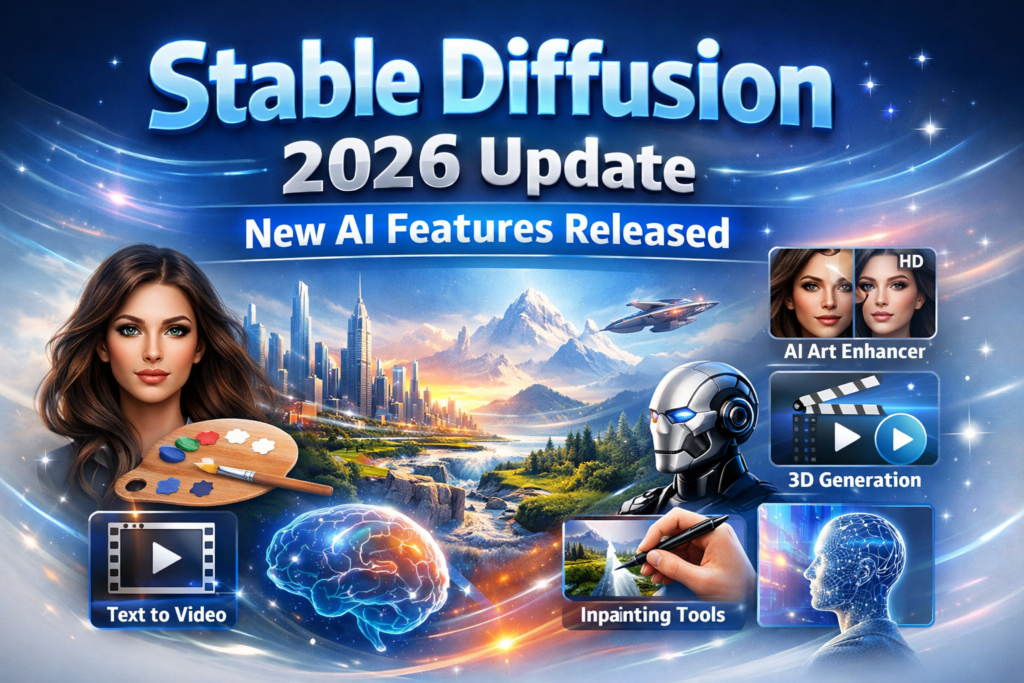
ToggleIn January 2026, Stable Diffusion once again revolutionized the world of AI image and audio generation. Content creators, game developers, and digital artists in the United States are rapidly adopting this new version. Significantly, this time it’s not just images; music and sound design have also become more realistic thanks to Stable Audio 2.5 AI.
Today at Digimathurreviews, we’ll be sharing the full details of the new AI features in the Stable Diffusion 2026 update. With this update, AI image generation has become even smarter and more realistic.
1. Stable Diffusion Update 2026: What’s New in the Latest AI Model Release
The new version of Stable Diffusion, released in January 2026, is smarter and faster than all previous versions. In the US, it’s being used extensively for digital marketing, YouTube thumbnail design, and NFT artwork. The new model now produces higher-resolution output, resulting in images that are sharper and more detailed than ever before.
The biggest highlight of this update is its improved understanding of human faces, skin tones, and lighting. Where previous versions produced an artificial look, the output now closely resembles photography. Stable Diffusion AI can now also accurately interpret complex prompts, such as “New York skyline at sunset with cinematic lighting.”
Its use is rapidly increasing in the USA, particularly for:
- Social media ad creation
- Game character design
- AI-based art projects
- E-commerce product images
The Stable Diffusion 2026 update demonstrates that open-source AI is no longer just an experiment but a professional tool. The new version has proven that AI is not just a technology but an integral part of the creative industry.
2. Stable Diffusion Current Status January 2026: How Popular Is It in the USA?
By January 2026, Stable Diffusion had become one of the most widely used AI image generators in the United States. It was being used by everyone from startups and freelancers to large media houses. Importantly, it could be used both for free and online, making it accessible to a broad range of users.
Its strong current status in the USA is due to several factors:
- It is open-source.
- It has become a viable alternative to expensive tools.
- It can run on local systems.
- It is also available on cloud platforms.
The Stable Diffusion AI generator is no longer limited to tech users; artists and non-technical people are also using it with ease. In 2026, its focus is on generating more realistic outputs and improving automation.
Stable Diffusion models are now being used in fashion design, architectural visualization, and AI storytelling. Its current status indicates that it is no longer just a trend but a permanent part of the AI ecosystem.
3. Stable Diffusion News Today (January 2026): AI Has Now Become a Brand Visual Designer
The January 2026 Stable Diffusion update has brought about a major transformation in the world of generative AI. Stable Diffusion is no longer just an image generation tool; it’s now capable of designing the entire visual identity for a brand.
According to new reports, this update includes multi-style blending, improved text-to-image accuracy, and an advanced neural rendering system, resulting in outputs that are more realistic and professional than ever before.
Major Improvements in Multi-Style Blending
The new version of Stable Diffusion now allows users to mix different art styles within a single image.
For example:
- Background: watercolor
- Character: realistic
- Text: comic or neon style
Previously, such images often appeared distorted, but now the system blends the styles smoothly. This gives creative designers and advertisers greater control.
New Neural Rendering System
The January 2026 update includes new neural rendering models that:
- Understand light and shadow more accurately
- Create natural depth and perspective
- Render skin tones and textures more realistically
This gives the generated images a 3D-like feel and reduces the need for further editing.
Improved Text-to-Image Accuracy
According to Stable Diffusion news 2026:
Prompts are now understood more effectively.
If the user writes:
“modern tech brand poster with neon lighting”
the output will have:
- The correct color theme
- Balanced lighting
- A clear composition
This change is considered particularly useful for branding and advertising creatives.
Auto Color Balance and Lighting Correction
The new feature includes:
- Automatic brightening of dark images
- Normalization of over-saturated colors
- More professional-looking lighting
- This reduces reliance on tools like Photoshop.
🇺🇸 Use in Digital Marketing in the USA
Digital marketing agencies in the USA are now using Stable Diffusion for:
- Facebook and Google Ads creatives
- Product mockups
- Brand posters
Where creating a single design previously took hours,
multiple versions are now being generated in seconds. This has accelerated A/B testing and is also reducing marketing costs.
AI in Brand Visual Design
Stable Diffusion news today, January 2026, shows that:
AI is no longer just a single image generator,
but is now creating for the entire brand:
- logo style
- color palette
- campaign creatives
According to experts, in the future, AI tools will become a core part of marketing and branding strategy.
Future Impact
Technology analysts believe that:
Tools like Stable Diffusion
are now moving from the role of a “creative assistant”
to that of a “visual brand architect.”
The impact will be clearly visible on:
the design industry
digital marketing
e-commerce branding
4. Stable Diffusion Latest Version 2026: Technical Improvements Explained
The latest Stable Diffusion version, released in 2026, features several major technical improvements. First, its model size has been optimized, allowing it to perform better even with less RAM.
Technical highlights:
- Faster image rendering
- Improved texture mapping
- Advanced shadow detection
- Better human anatomy generation
In the USA, game developers are using it to design NPC characters, while the film industry is employing it for creating concept art and background scenes.
This latest Stable Diffusion version, as of January 2026, demonstrates that AI is improving not only in its output but also in its performance.
5. Stable Audio 2.5 AI: The New Era of Stable Audio Music Creation
The biggest surprise of the 2026 update was Stable Audio 2.5 AI. Stable Diffusion is no longer limited to just images; it has now entered the world of music and sound generation.
The Stable Audio music system can now:
- Create background music
- Generate cinematic sound effects
- Design podcast intros
- Create game soundtracks
Content creators in the USA are using it to create royalty-free music. Where music licensing was previously expensive, AI is now making it possible to create soundtracks for free.
Stable Audio 2.5 AI demonstrates that in the future, both visual and audio content will be created using AI.
6. Stable Diffusion AI Generator: Free vs Online Usage in 2026
In 2026, the Stable Diffusion AI generator is being used in two main ways:
a free local version (Local Installation) and an online cloud version (Online Cloud Version).
In the US, in particular, freelancers, startup designers, and independent creators are preferring the local version because their data remains on their own systems and is not uploaded to any third-party server. This ensures both data privacy and control.
On the other hand, the online cloud version is popular among users who don’t want to deal with technical setup and prefer to generate AI images directly from their browser. Both versions are proving useful depending on different user needs.
Stable Diffusion Free (Local) Version:
- Open Source:
It is completely open-source, meaning developers and creators can modify it and customize the system according to their needs. This is why it is more popular among tech-savvy users.
- Custom Model Support:
Users can use custom-trained models tailored to their industry or brand.
For example:
- Fashion design
- Product photography
- Game characters
- Brand logo design
- Advanced Controls:
The local version offers advanced options such as:
- seed control
- sampling method
- resolution tuning
- negative prompts
This provides greater control over the output and delivers professional results.
Stable Diffusion Online (Cloud) Version:
- No Installation Required:
Users don’t need to download any software or set up a GPU. Simply open a browser, enter the prompt, and the image is generated.
- Faster Processing:
Cloud servers run on powerful GPUs, therefore:
- image generation is faster
- high-resolution output is delivered quickly
- bulk image generation becomes easier
- Easy Interface:
It features:
- a simple dashboard
- ready-made templates
- one-click generation
These features make it easy for non-technical users to create AI images.
Overall
The free local version of Stable Diffusion is better for users who:
✔ want data privacy
✔ want to use custom models
✔ want advanced controls
While the online cloud version is useful for those who:
✔ want to work without any setup
✔ want faster results
✔ prefer a simple interface
7. Stable Diffusion Models and Their Role in 2026 AI Creativity
In 2026, Stable Diffusion models have become even more prominent. Now, specialized models are being developed for various industries, such as fashion models, architecture models, and cinematic models.
Stable Diffusion models can now:
- Be trained in different styles
- Be customized with local datasets
- Create brand-specific artwork
Fashion companies in the USA are using them for virtual clothing design.
8. Stable Diffusion 2026 News: Future of Stable Diffusion AI in America
The Stable Diffusion 2026 update proves that the future of AI is not just automation, but creativity. In the US, it is being adopted in school education, gaming, and digital media.
Future possibilities:
- AI movies
- AI fashion shows
- AI-generated ads
- AI music albums
Stable Diffusion AI has now become more than just a tool; it’s a digital creation platform.
Final Thoughts
The Stable Diffusion 2026 Update and Stable Audio 2.5 AI clearly demonstrate that artificial intelligence is no longer just a technological tool, but has become an integral part of art, design, and the creative industry. From image generation to music and sound design, AI is now producing outputs that were previously only achievable by professional artists and studios.
In the United States, digital marketing agencies, content creators, and brands are rapidly adopting these tools, significantly reducing both production time and costs. Furthermore, multi-style visuals and AI-generated audio are enabling brands to develop more unique and compelling identities.
2026 is considered a pivotal year because it marks the point when AI tools are moving beyond the experimental stage and entering mainstream adoption. This convergence of AI and creativity has the potential to reshape the entire industry in the years to come.