Table of Contents
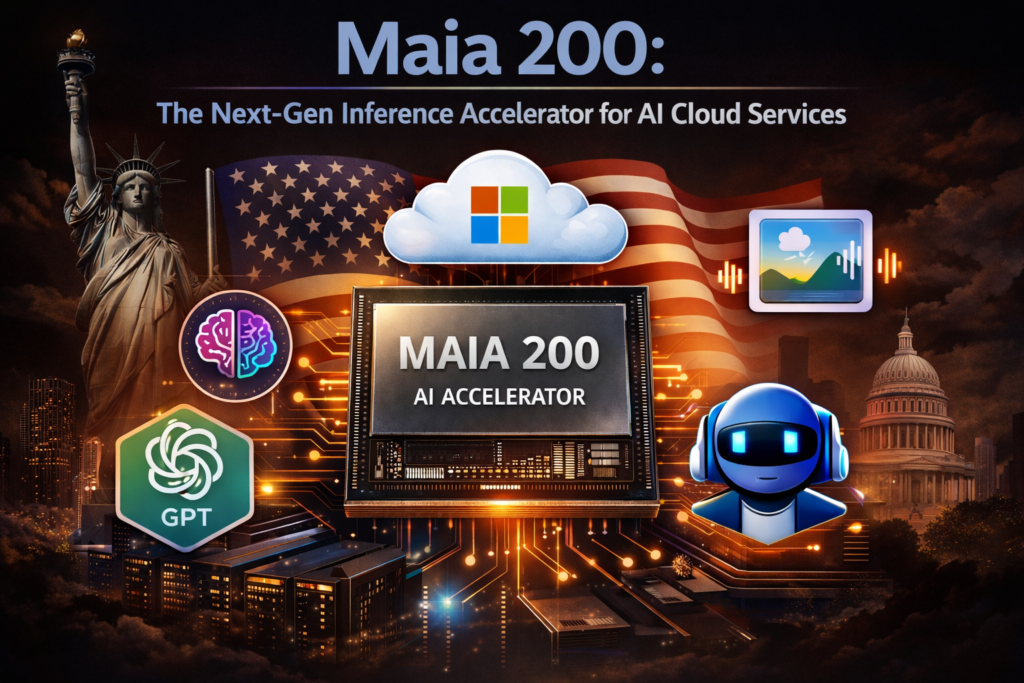
ToggleThe world of AI is no longer confined to research labs. Today, AI has become a core component of every cloud service, every mobile app, and every enterprise solution. To handle this rapidly growing demand for AI, Microsoft has introduced its new inference accelerator – Maia 200.
Maia 200 is specifically designed for AI inference workloads. Its objectives are:
- Faster response times
- Lower energy consumption
- Easily serving large language models
- Making AI services on the Azure cloud scalable
In this article, we will understand in detail what Maia 200 is, how it works, and why it is being called the next-generation AI inference accelerator.
Learn about Microsoft’s new Maia 200 chip on Digimathurreviews, which makes AI inference faster and more cost-efficient. This next-generation accelerator, which optimizes GPT, Copilot, and multimodal AI models, is setting new standards for performance and scalability in Azure cloud workloads.
1. Maia 200: A Breakthrough AI Inference Accelerator
Until now, the AI hardware market has been dominated by chips like NVIDIA GPUs, Google TPUs, and AWS Trainium. But with the Maia 200, Microsoft has made it clear that it wants to be a leader not only in software but also in AI hardware innovation.
The Maia 200 is designed to:
- Focus on inference rather than training
- Support large-scale AI services
- Be optimized for cloud data centers
Why is it being called a breakthrough?
It’s a breakthrough because:
- This chip is specifically designed for inference
- It’s not a multi-purpose chip like a generic GPU
- Its architecture is tuned to increase AI response speed
For example, when a user uses Copilot or a GPT-based service, inference is happening behind the scenes—the model takes input and provides output. The Maia 200 makes this process much faster and more efficient.
2. Engineered for High-Performance AI Inference Workloads
Let’s understand this heading from a technical perspective.
AI inference faces three major challenges:
- Latency (delay in response)
- Throughput (how many requests can be handled simultaneously)
- Power efficiency
The Maia 200 is designed as a solution to all three of these problems.
The engineering behind the performance:
- The Maia 200 uses a high-bandwidth memory architecture.
- It has specialized AI cores.
- Data movement is minimized.
This means:
Model parameters are accessed quickly from memory.
Computation is fast.
And the output reaches the user quickly.
To understand this with a real-life example:
A GPU is like a general highway,
while the Maia 200 is an express AI highway —
on which only AI inference traffic runs.
3. Optimized AI Systems with Advanced Memory and Networking
Now let’s talk about the system-level optimization of the Maia 200.
Today, AI models have become so large that memory becomes a bottleneck.
If the memory is slow, even the fastest processor will be useless.
Maia 200’s memory advantage
The Maia 200 features:
- Advanced HBM (High Bandwidth Memory)
- Low latency memory access
- Efficient caching system
The benefits:
- Large language models fit easily into memory
- No need to fetch data repeatedly
- Lower inference costs
Networking optimization
In a cloud environment, a single chip doesn’t operate in isolation —
it’s connected to thousands of chips in the data center.
The Maia 200:
- Supports high-speed interconnects
- Enables cluster-level inference
- Simplifies multi-node AI serving
This allows for:
- Distributed inference on the Azure cloud
- Smooth operation of large-scale tools like Copilot
4. Cloud-Native Development and Developer Tooling with Maia SDK
Now let’s understand this technology from a developer’s perspective.
Because no matter how powerful a chip is, if developers can’t easily use it, its practical value is almost eliminated. The real power emerges only when hardware and software work together.
To solve this problem, Microsoft has developed the Maia SDK. Its goal is to eliminate the need for developers to learn new hardware; instead, they can leverage the power of the Maia 200 chip with their existing tools and frameworks.
The Maia 200 was built from the ground up with a cloud-native design philosophy. This means the chip is not designed for on-premise or isolated systems, but specifically for cloud workloads. It includes virtualization support and is fully integrated with the Azure AI stack. This integration eliminates the need for developers to write separate hardware-specific programming.
The biggest advantage for developers is that they can use the same AI frameworks they are already familiar with. Whether it’s TensorFlow, PyTorch, or an existing trained model—they can be deployed on Azure without significant modifications. Behind the scenes, the Maia 200 optimizes the model at the hardware level.
The Maia SDK simplifies this entire process. It provides tools for model optimization, tunes the inference pipeline for better performance, and makes debugging and profiling much simpler. This means developers don’t need to write low-level chip instructions.
This approach makes the workflow very straightforward.
The developer simply writes the model, deploys it on Azure, and the Maia 200 automatically optimizes performance. This method is completely different from traditional hardware programming, where developers had to learn different code and optimizations for each chip.
This entire system focuses more on making the software “comfortable” than making the hardware “smart,” so that AI developers can focus on innovation, not on the complexities of the hardware.
Key Points (Concise and clear):
- Maia 200 is designed from the ground up for cloud workloads.
- It features deep integration with the Azure AI stack.
- Developers don’t need to learn new hardware.
- Existing AI models can be easily deployed.
- The Maia SDK assists with automatic optimization, debugging, and profiling.
5. Built on Cutting-Edge TSMC 3nm Process Technology
The Maia 200 is built on TSMC’s advanced 3nm fabrication process, considered the most cutting-edge semiconductor technology available today. The 3nm process allows for more transistors to be packed onto a single chip, increasing its computing power while reducing power consumption. This is why the Maia 200, despite its smaller size, is faster and more efficient. Lower power consumption directly translates to less heat generation, reducing the strain on cooling systems in data centers.
To put it simply, older AI chips were like bulky petrol engines, while the Maia 200 is like a modern hybrid engine – delivering more performance with less energy. AI inference runs 24/7, so efficiency matters every second. This chip’s design focuses on energy savings, resulting in significant long-term operational cost savings for large cloud providers and a reduced carbon footprint.
Key Points:
✔️ 3nm process delivers higher performance per watt
✔️ Reduced heat generation lowers cooling costs
✔️ High efficiency is ideal for 24/7 AI workloads
6. Seamless Integration into Microsoft Azure Cloud Services
The Maia 200 is not just an AI chip; it has become a core component of Microsoft’s Azure cloud ecosystem. Designed specifically for Azure AI services, Copilot, and GPT-based applications, it addresses the growing AI workloads in the United States.
Key Highlights (USA Perspective):
1. Azure AI & Copilot Optimization
The Maia 200 is tuned for Azure OpenAI, Microsoft Copilot, and enterprise AI tools, providing US businesses with faster and more stable inference.
2. Lower AI Inference Cost
Cost is a major challenge for large-scale AI adoption. The Maia 200 reduces the per-query processing cost, making AI more affordable for American cloud companies.
3. High Scalability for US Enterprises
Healthcare, finance, and SaaS companies can easily handle millions of AI requests without performance degradation.
4. Enterprise-Grade Reliability
The Maia 200 is deeply integrated with the Azure infrastructure, improving service uptime and AI application stability.
This is why Microsoft is deploying it at scale in its US data centers.
7. Competitive Performance versus Trainium and TPU Chips
The market already has AWS’s Trainium, Google’s TPU, and NVIDIA’s GPUs. However, these three serve different roles. The NVIDIA GPU is a general-purpose processor that handles everything from gaming to AI. This is why it’s powerful, but also costly and energy-intensive for AI inference. On the other hand, TPUs and Trainium are cloud-specific chips—TPUs are limited to Google Cloud, and Trainium is exclusive to AWS.
Maia 200 is Microsoft’s version of this strategy, but its focus is specifically on AI inference. This means that when a user uses Copilot, runs a GPT-based service, or makes an Azure OpenAI API call, the Maia 200 efficiently generates the model’s response. Because it doesn’t perform general-purpose tasks like a general GPU, but is optimized solely for AI inference, it becomes more efficient and less power-hungry.
Maia 200’s biggest competitive advantage is that it’s native to the Azure ecosystem. Microsoft designed it with its own software stack in mind—such as Azure AI services, Copilot workloads, and GPT-based enterprise apps. This means both the hardware and software are under Microsoft’s control. This leads to better performance tuning and lower costs.
From a business perspective, Maia 200 makes Azure more competitive. Just as TPUs benefited Google Cloud and Trainium benefited AWS, Maia 200 strengthens Microsoft’s position in the AI race. Customers directly benefit from this because they get cheaper AI inference, a more stable service, and better scalability.
In simple terms:
NVIDIA GPU = powerful but expensive
TPU = Google-only
Trainium = AWS-only
Maia 200 = Azure-only but inference-optimized
And this is its real competitive edge—Microsoft is no longer just a software company, but a company that controls both AI hardware and AI software.
8. Real-World Deployment and AI Model Support (GPT & Copilot)
The Maia 200 was not designed solely for research labs or testing, but rather specifically for real-world AI workloads. Today, Microsoft is actively deploying it in its Azure data centers, where it processes millions of AI requests daily. Importantly, the Maia 200 is optimized for large language models like GPT, multimodal AI systems, and enterprise-level AI applications.
This chip powers Microsoft Copilot, chat-based AI assistants, and image and text-based AI services. When a user asks a question in Copilot or receives a response from the Azure OpenAI API, accelerators like the Maia 200 are working behind the scenes to power that inference process. This means the technology is not just theoretical but is being used practically and commercially.
For end users, the direct benefits include faster response times, lower latency, and a more reliable AI experience. AI services respond quickly, and system downtime is reduced, increasing user confidence. From a business perspective, the Maia 200 proves cost-efficient for both cloud providers and enterprises, as it reduces the cost per query and can handle larger workloads with fewer resources.
This is also a significant change for developers. They don’t need to worry about hardware-level optimization. They can develop their AI models using standard frameworks and easily deploy them on the Maia 200 through Azure’s tools. This allows developers to focus entirely on model quality and application logic, rather than on chip tuning.
Supported AI Models
- Maia 200 is designed for real-world AI workloads, not just for testing.
- It supports a wide range of AI models:
- Large Language Models (LLMs) like GPT
- Multimodal AI (image + text + data)
- Enterprise-grade AI models
AI Services Powered by Maia 200
- Microsoft Copilot
- Chat-based AI assistants
- Image + Text-based AI systems
- Azure OpenAI Services
Real-World Impact (End Users)
- Faster and smoother AI responses
- Lower latency and reduced downtime
- More stable and reliable AI experience
Business Impact
- Lower cost per AI query
- Better utilization of cloud infrastructure
- Easier AI deployment at scale
- Improved performance and scalability
Developer Benefits
- No need to worry about hardware optimization
- Ability to use existing AI frameworks
- Easy integration with Azure tools
- Complete focus on model development
Final Thoughts: Why Maia 200 Matters
Maia 200 is not just a new chip; it’s a crucial part of Microsoft’s AI strategy. It demonstrates that the future of AI lies not only in building better models but also in the deep integration of hardware and software. Maia 200 accelerates AI inference, makes cloud services more efficient, and gives Azure a strong competitive edge in the market.
In the future, AI requests will increase rapidly, and inference costs will become a major factor. This will drive demand for chips specifically designed for AI. In this race, Maia 200 could become a powerful weapon for Microsoft, helping it maintain its lead in the long-term AI competition.
Fead More Best AI Tools –
AI Tools Americans Are Using Every Day in 202
Top 20 Generative AI Tools for Americans in 2026