Table of Contents
ToggleThe most talked-about news in the tech world right now is the EU warning to Meta, stating that restricting WhatsApp to Meta’s own AI could be anti-competitive. If WhatsApp opens up to third-party AI chatbots in the future, it would be a major shift in the digital world, similar to the App Store or the open platform of social media. This entire issue will impact not only tech companies but also bloggers, online businesses, digital marketers, and ordinary users. This is why this news is trending rapidly and is also appearing on Google Discover. In this article, we will delve into this entire issue in simple language so that you can get complete information in one place.
At DigiMathurReviews, we provide you with valuable information on the latest tech, AI, and digital trends in simple language, so you can stay current with changing technology and make informed decisions at the right time. In this article, we’ll explore the Meta-EU-WhatsApp AI controversy in detail and how it could impact your digital world in the future.
1. What is the Meta-EU dispute? Understand the full story in detail.
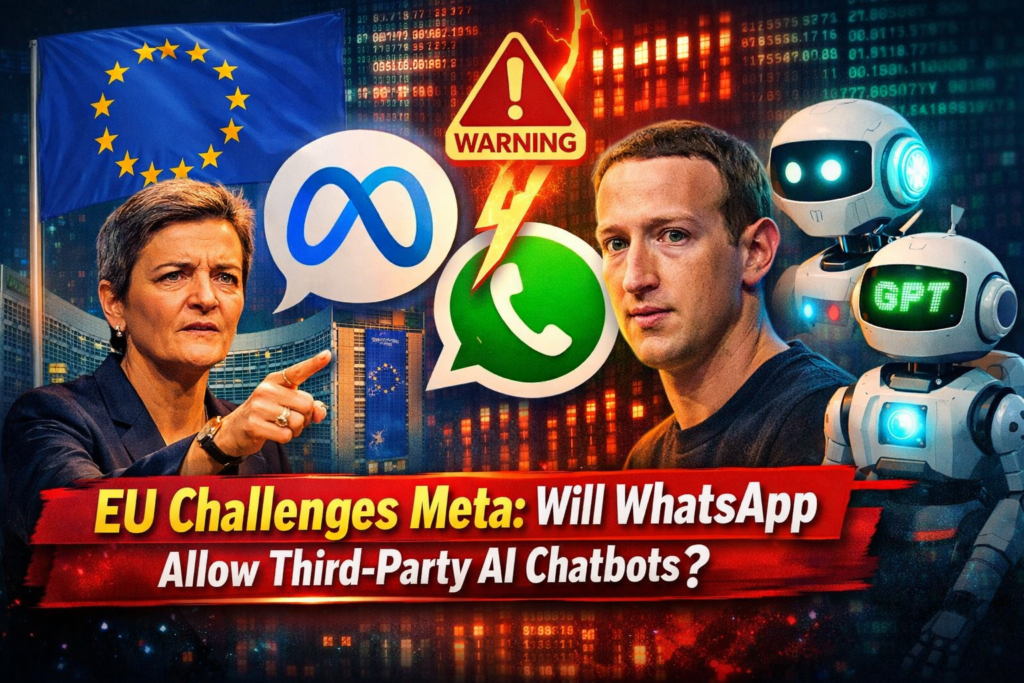
The European Union has long been monitoring large tech companies to ensure they don’t misuse their platforms to stifle competition. Recent reports have revealed that Meta may limit access to external AI services on WhatsApp. The EU believes this could violate the principles of the Digital Markets Act (DMA), which aims to keep large platforms open and fair. If a company uses its dominance to block other AI tools, it could negatively impact smaller startups and innovation. This is why the EU has warned Meta not to make WhatsApp a closed ecosystem. This issue has now become a global tech policy debate.
Could your WhatsApp become more than just a chatting app, but a full-fledged AI assistant? This question is what makes this controversy even more interesting.
2. Why could the launch of AI chatbots on WhatsApp be a watershed moment?
WhatsApp is one of the most widely used messaging apps in the world. If multiple AI chatbots become available, AI will directly become a part of billions of people’s everyday conversations. Instead of opening a separate app, people will be able to write content, ask questions, manage their businesses, and provide customer support right within WhatsApp. This could significantly boost the digital economy. Small businesses, freelancers, and creators will also directly benefit from powerful AI tools. This is why experts are calling this potential transformation the biggest tech shift since the mobile internet.
Imagine—if you could write articles, create images, and earn money all from a single WhatsApp chat, it would completely transform the way digital works.
3. What is Meta’s stand and why is the company exercising caution?
Meta states that its primary focus is user safety and data privacy. Opening WhatsApp to countless third-party AI tools could lead to increased issues like spam, misinformation, fraud, and data leaks. The company also believes that it has invested heavily in its AI ecosystem, and therefore should have the right to maintain the quality of its platform. Regulators, on the other hand, argue that stifling competition in the name of security is unfair. This balance—security versus openness—is the core issue at the heart of this entire controversy.
The real question is—can large platforms stifle future competition in the name of security?
4. Impact on ordinary users, bloggers and online earners
If WhatsApp opens up to AI, the biggest benefits will be for ordinary users and digital creators. People will be able to write articles, create scripts, automate business processes, and communicate with customers directly on WhatsApp through AI chat. This will open up new avenues for online revenue generation—especially for affiliate marketing, digital services, and local businesses. For bloggers, this could become a new way to increase traffic, as AI-driven chat will be able to directly share website links. However, this will also pose challenges such as data security and misinformation, which will need to be controlled.
In the future, a significant portion of website traffic may come directly from WhatsApp AI.
5. EU crackdown means a new era for Big Tech
Over the past few years, the EU has fined several major tech giants and implemented new laws. The aim is to ensure that the digital world is not limited to a few companies. Regulations like the Digital Markets Act and the Digital Services Act are considered major steps towards making the tech industry more transparent. The WhatsApp AI controversy is part of that strategy. Experts believe that in the future, other countries around the world may also implement similar regulations, which could change the strategies of global tech companies.
If the EU’s model is successful, the rules for Big Tech could change worldwide.
6. Will AI like ChatGPT really come back on WhatsApp?
This is the biggest question. If EU pressure works, WhatsApp could see multiple official AI chatbots in the future. This would eliminate the need for users to install separate apps and provide a complete digital experience in one place. However, this may take time as legal procedures, technical changes, and security testing will be necessary. Still, the trend is clear—messaging apps are gradually becoming AI super-apps.
The day powerful AI arrives on WhatsApp could change the way we use the internet.
7. The future: Balancing AI, privacy, and the open internet
This conflict between Meta and the EU isn’t just news of today, but a signal that will shape the course of the coming decade. If platforms open up, innovation will accelerate and users will have more choice. If they remain closed, the control of a few companies could increase. Therefore, the internet of the future will likely be one where a balance of open access, strong privacy, and smart AI will be essential. This WhatsApp case is being seen as the beginning of that change.
The future will determine whether the internet will remain open or be limited to a few large companies.
8. Meta EU WhatsApp AI Update 2026: Latest Changes and Prospects
This entire matter involving Meta, the EU, and WhatsApp reveals the future of AI integration in 2026. If regulations force WhatsApp to open up to third-party AI, it would be a major shift in the tech industry. This would provide opportunities for new AI startups and allow users to access a variety of smart services on a single platform. Companies may also have to redesign their policies, data security, and user experience. This is why experts are counting this update as one of the most important AI news of the coming years.
2026 could be the year when WhatsApp becomes more than just a chatting app, but a full-fledged AI platform.
9. How will the Meta EU WhatsApp AI controversy change the future tech world?
This dispute isn’t limited to just one company or app; it will determine how open and competitive the internet of the future will be. If major platforms are forced to open their systems, innovation will accelerate and users will have more choice. However, if controls increase, the dominance of a few companies could become stronger. Therefore, the Meta-EU-WhatsApp AI controversy is being considered a turning point in the coming digital age. Tech experts believe that striking a balance between AI, privacy, and open access will be the biggest challenge in the future.
The decision made today will determine how free the digital world of tomorrow will be.
Final Words
The Meta EU WhatsApp AI news is currently among the most important discussions in the tech world, as it is directly related to major changes like WhatsApp third-party AI chatbots, EU warning to Meta, and ChatGPT on WhatsApp future. If WhatsApp indeed opens up to multiple AI services in the future, it could completely transform digital communication, online business, and content creation. Furthermore, the WhatsApp AI update 2026 could offer users features like smart search, automation, and personal AI assistants all on one platform.
More about AI tools updates: